

Publication
Uncovering the Rule of Law in European Countries
Law & Social Inquiry
Abstract
This article examines the multifaceted nature of the rule of law. It primarily shows a way to measure how the meaning of the rule of law differs across countries, or across different contexts more generally, by analyzing parliamentary discourse on the rule of law. The findings point to a convergence in the conceptualization of the rule of law across diverse legal traditions despite *ex ante* differences between common law, French, German, and postsocialist legal traditions. The article also proposes a principled approach for deriving weights for rule-of-law indicators in order to assess the sensitivity of country rankings with respect to the adherence to rule-of-law principles.
Research highlight
Key highlight
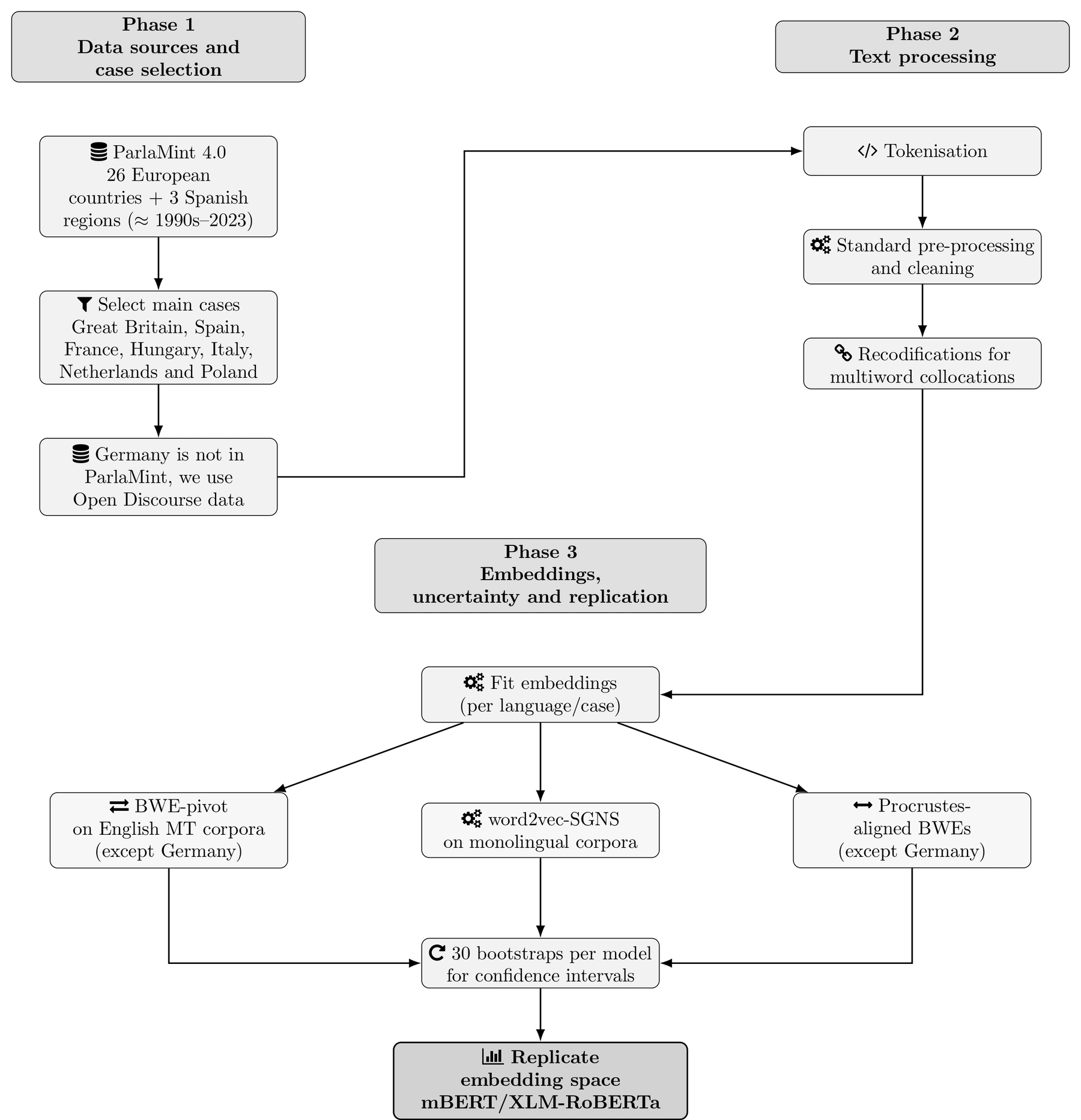
Our empirical strategy is based on natural language processing (NLP) and a text-as-data approach, specifically word vectors. In this context, we relied on cross-lingual word representations in both monolingual and bilingual word embeddings (BWEs). The latter implies shared embedding space for words across two languages, while multilingual word embeddings apply to more than two languages (Klementiev, Titov, and Bhattarai 2012; Chen and Cardie 2018). In the case of BWEs, it is usual to map two different languages using a fixed target, generally English (Chen and Cardie 2018; Lample et al. 2018). This process involves machine translation to the target language; therefore, the implementation could be called a BWE pivot, while learning embeddings without translation by using languages of the same family—for example, German and Dutch, which are both West Germanic languages—is BWE-direct implementation (Chen and Cardie 2018). Although using a fixed language as a pivot should guarantee cross-lingual comparison, there are some drawbacks. For example, BWE-pivot applications tend to be costly in terms of time and resources. However, a direct application between two similar languages could take advantage of linguistic interdependence and improve performance. We applied monolingual and BWE applications to eight countries of ParlaMint and Open Discourse data between 2015 and 2022—namely, Germany, Spain, France, Great Britain, Hungary, Italy, Netherlands, and Poland. This selection comprises around 2.6 million speeches, almost 380 million words for the original languages and around 368 million for the machine-translated corpora, with the exception of Germany, for which we only have monolingual corpora.