
Publication
Machine Learning and Political Events: Application of a Semi-supervised Approach to Produce a Dataset on Presidential Cabinets
Social Science Computer Review
Abstract
This paper describes the creation of a novel dataset on ministerial turnover and resignation calls in 12 presidential cabinets in Latin America from the mid-1970s to the early 2020s. The indicators on resignation calls and reallocations of cabinet members are entirely novel. Both constitute a relevant empirical contribution not only to the study of political dynamics in presidential systems and cabinet politics but also to public opinion and public policy topics. We focus on the creation of the dataset using optical recognition algorithms on press report archives together with machine learning models. The models permitted the training of ensemble semi-supervised classifiers over a period of almost 50 years. Subsequently, we provide a number of measurement validity checks to cross-validate the dataset by comparing it with similar existing data and an exploratory analysis.
Research highlight
Key highlight
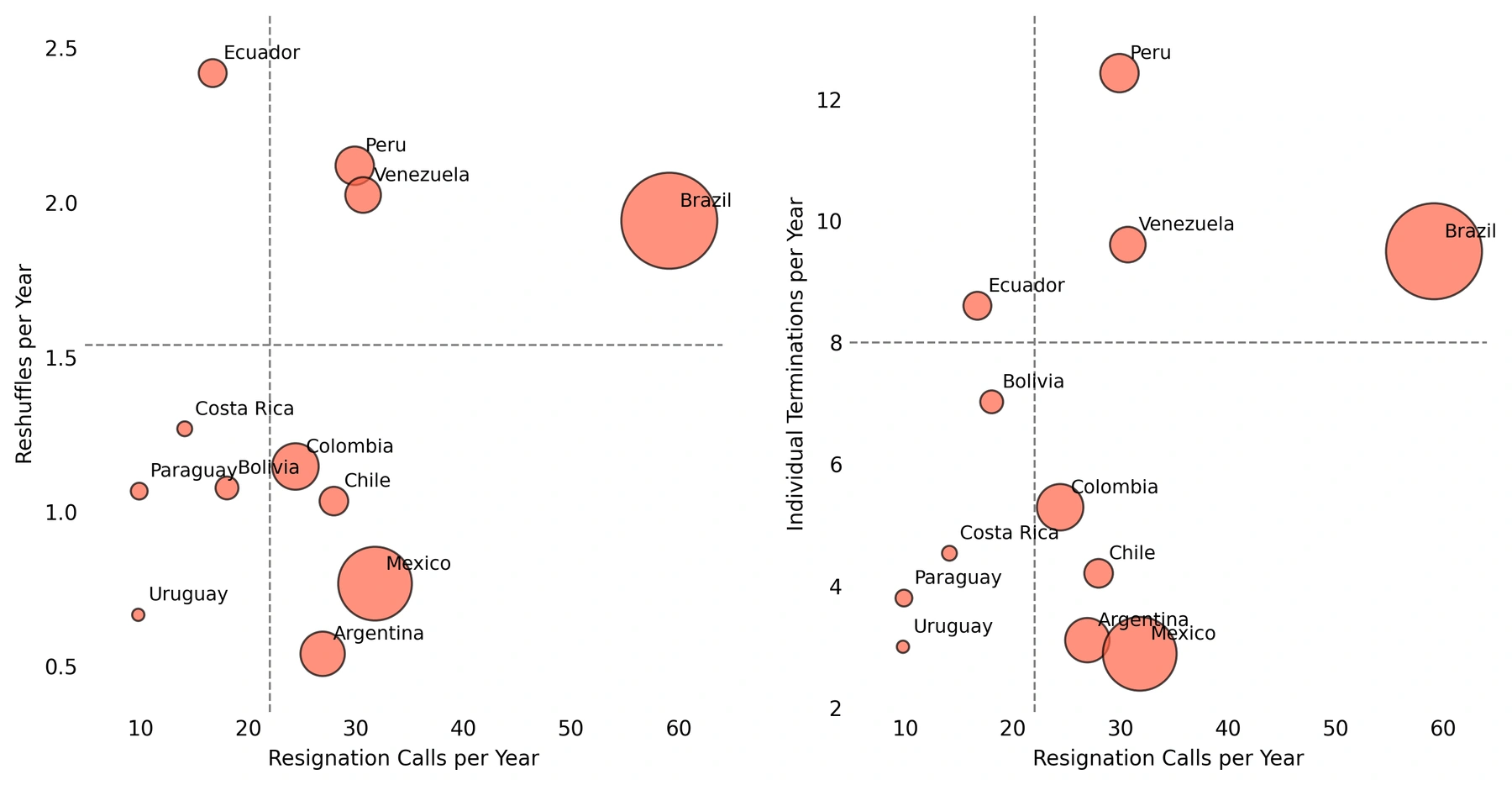
Figure 4 provides an overview of the dataset through an exploratory analysis that shows the relationship between reshuffles, individual terminations, and resignation calls by country. Four groups of countries stand out. First, Ecuador, in the upper left sector, albeit having a high number of both reshuffles and individual terminations, has fewer resignation calls. This relationship could suggest that ministerial adjustments are associated with internal conflicts rather than random shocks. Second, there are cases with high cabinet turnover and a high number of resignation calls per year in the upper right sector, denoting a significant level of instability. This group includes cases such as Brazil, Peru, and Venezuela. Third, in the lower left sector are countries with comparatively low cabinet turnover per year and fewer questioning of cabinet members, such as Bolivia, Costa Rica, Paraguay, and Uruguay. Finally, in the lower right sector, a group of countries that includes Argentina, Chile, Colombia, and Mexico, there is cabinet stability but an important number of resignation calls.