

Publication
Blame Shifting in Presidential Systems: Ministerial Terminations’ Corrective Effect on Approval
Public Opinion Quarterly
Abstract
How do ministerial terminations affect presidential approval? Presidents face unexpected challenges related to stochastic events such as scandals, policy failures, or economic crises. We argue that the termination of ministers who have received calls for their resignation presents an opportunity for the president to send signals to the electorate in the expectation of a corrective effect on popularity through a blame-shifting dynamic. The central argument is that this dynamic occurs only in coalition governments where political responsibility may be more easily attributed to the coalition’s different parties and factions, weakening personalization centered on the president and facilitating blame shifting and the corrective effect. The expectation of a corrective effect on approval is tested using instrumental variables (IV) regressions applied to novel data on ministerial terminations and resignation calls in 124 governments in 12 presidential democracies. The data were gathered by combining data mining, machine-learning techniques, and survey marginal time series based on the dyad ratios algorithm for approval. The main findings support the expectation that individual terminations of tainted ministers generate a corrective effect of nine points on presidential approval in coalition governments, which decreases in the medium and long term.
Research highlight
Key highlight
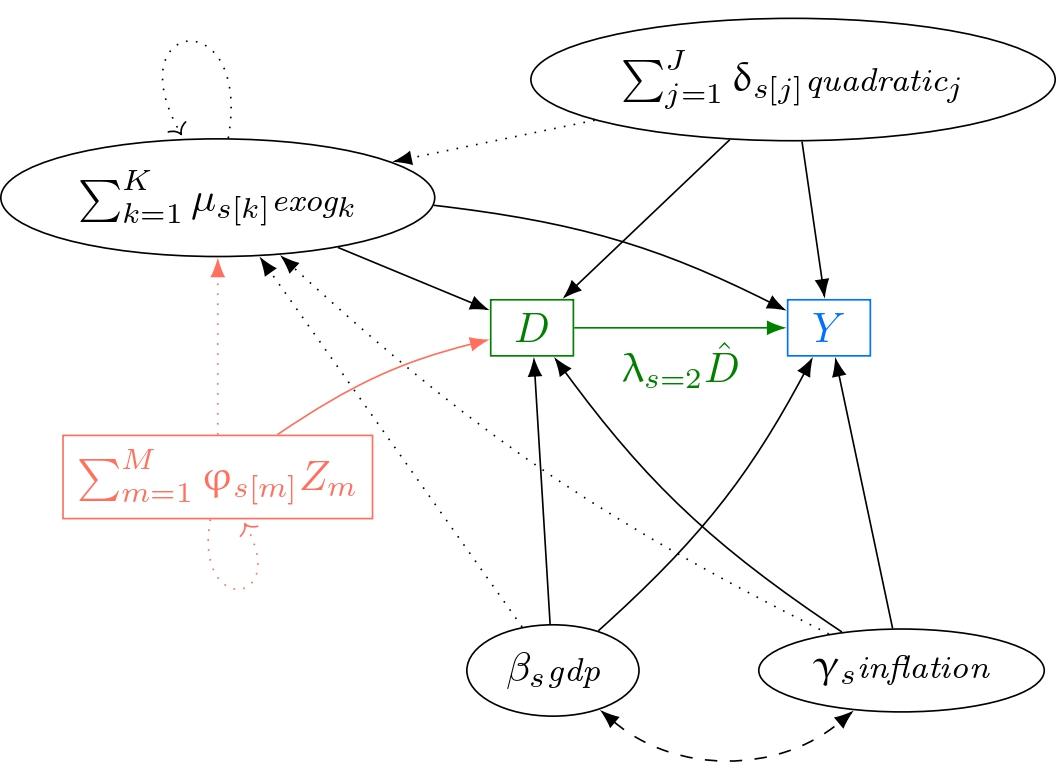
The identification and causal inference strategy of the empirical analysis is based on IV regressions. Therefore, in addition to the endogenous variable *D* and the *k*-th vector, we incorporated an *m*-th vector of three instruments that, like most of the covariates, were operationalised considering the previous quarter: (i) ministers’ average age Z1; (ii) the square of ministers’ average age Z2 to control for non-linear effects; and (iii) the proportion of nonpartisan ministers Z3. The rationale for the selection of these instruments is associated with the identification strategy, which is summarised in the points below, following the logic of some IV designs identified by the literature and a causal structure based on a directed acyclic graph (DAG).